
Repower, Reinstall, and Decom: Making New Work Out of Old
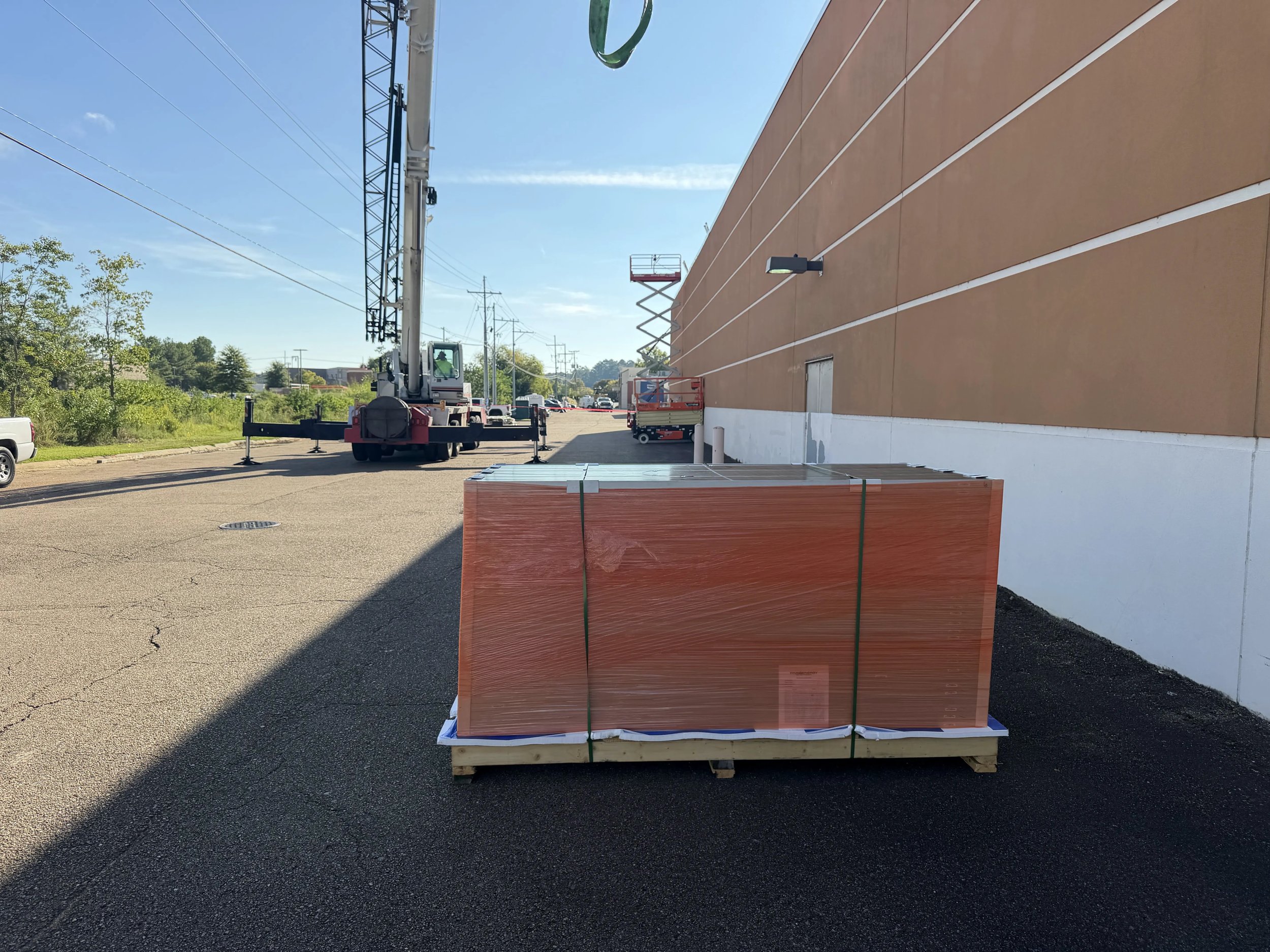
Beautifully repalletized modules in Flowood, Mississippi.
The fun part of the solar industry is building new systems. Generally, that’s where the headlines are, but as our industry builds more and more new stuff, the opportunities to fix, improve, and sometimes, remove old stuff is growing. We’re so excited to have found this work to add to our capabilities.
This fall, we're active on two types of repower and module swap projects across six states.
In Bowling Green, Kentucky, we were hired to repower a nearly 2MW ground mount system. The scope: uninstall over 7,000 older 280W modules, palletize them for removal, and install 5,394 new 370W modules in their place. Fewer panels, more power.
The complexity started before we broke ground. The new modules were physically larger than the ones they replaced. During bidding and preconstruction, Matias Koski, Preconstruction Manager, David Hearn, Project Manager, and Shivam Bavishiya, Assistant Project Manager, planned for that by thinking about potential changes to the racking. When we arrived on site, we were ready. The crew was led by our superintendents Juan Lucena and Marty Miller, and the entire team adapted as conditions required, including addressing rusted hardware from the original installation that slowed removal.
After Bowling Green, Juan and Marty moved to rooftop module swap work that's been keeping us busy across sites in Loveland, Colorado; Douglasville, Georgia; Bourbonnais, Illinois; Kokomo, Indiana; and Flowood, Mississippi.
The scope at each site: uninstall existing modules and MLPEs, palletize and document every module by serial number, install new racking components required by different sized modules, install modules and MLPEs, and volt test each string before leaving the site.
On rooftop module swaps, palletization is one of the highest-risk steps. This is especially true on our current projects because the roof parapet is too high to allow the safe use of a telehandler to remove the pallets. So we’re palletizing on the roof and then removing by crane. These pallets are stacked carefully, wrapped, banded, and craned down. David Hearn developed a 14-step palletization process for this portfolio – foam board placement, glass-up stacking, frame alignment checks, edge protection, banding specifications, serial number documentation, and timestamped photography at each stage. Every pallet is built the same way at every site. That consistency protects the modules, documents the work, and gives the client confidence throughout.
Repower, module swap, uninstall/reinstall, and decommissioning work is increasing for three reasons: systems installed in the early 2010s are aging, tariffs have made new module sourcing complicated and sometimes urgent, and roofs that hosted solar systems need periodic replacement. When any of these factors converge, the owner of an operating system needs a subcontractor who can manage the work without causing additional problems.
Pine Energy brings preconstruction planning, documented processes, experienced field leadership, and the flexibility to adapt when conditions change. We've built these capabilities across rooftop and ground mount systems.
If you have repower, uninstall/reinstall, or decommissioning work in your future, please be in touch. We’d love to perform the project safely, kindly, and professionally for your clients and partners.